Thursday, November 24, 2011

Thanks Giving

            Thank you for my fingers and my toes.  Thank you for the clock that ticks softly next to me and the sound of the water running through the pipes as Melissa takes her shower.  And for this window that lets me see out but keeps the warm in.  Thank you for the color of the early morning sky – how the edge glows gold while the vast space above shimmers the faintest purple.  And how the trees rise up slender and graceful—intricate dark lines traced effortlessly against the coming light.
             Thank you for my nose that secretes mucus and knows how to sniffle at just the right time.  And for the porcelain mug of steaming tea with silly blue lines around the rim that I am drinking from.  And thank you for the people who harvested the tea leaves and processed them and put the tea in shiny silver pouches in cardboard boxes.  And for the people that worked the ships and planes and trucks and trains that brought the tea from that unknown place to here.  And thank you for the young man who opened the carton and put the tea boxes on the shelf and the woman who took my wife’s money as she checked out.
             Oh yes, and thank you especially for my wife, the one in the shower, and for my daughter, the one in California.  And for my mother and fathers and sisters and brother and nieces and uncles and teachers and friends and colleagues and acquaintances – wherever they are.  And for everyone else who walks or sits or lies down on the face of this earth.  And for everything else that flies or runs or slithers or swims or grows or doesn’t grow in this world and in all the worlds beyond.
             Thank you for this everything that is beyond comprehension.  Thank you for beyond beyond.  For the electric mystery of the human heart and the nuclear wonder of stars and for starlight traveling unfathomable distances to tickle my fragile eyes.  And thank you for my third eye and my fourth eye and for all my eyes and hands and legs and tree trunks and houses and bombs and fighters and prisons and monasteries and whore houses and banks and TVs and couches and fingers—ah yes—thank you for the fingers.

Tuesday, November 1, 2011

Crossing Over

It’s late afternoon Sunday, at Naco, Arizona and I’m crossing one of the most heavily fortified borders in the world.  Past the ugly metal fence—ten feet high and running off into the desert land as far as I can see.  Past the friendly American guards who ask if we have guns or bullets.  (The correct answer is no.)  Past the Mexican guard post and the speed bumps that would wreck your car if you were going more than two miles per hour.
            Then I’m in Mexico.  The country of violence and corruption.  I’ve read about the executions and the torture—the drug cartels with their own armies—the legions of fear.  Even my mother, usually an advocate for travel and adventure, encouraged me not to cross over. 
I am with a trusted friend who speaks the language and spends part of his life across the border.  Still I am uneasy.  Is this safe?  Am I safe?  I am stepping into the unknown.  But I remember being a high school exchange student in Japan in the spring of 1970.  The anti-war protests were at their height and the Kent State killings had just happened.  Several of my friends tried to convince me not to go to college when I returned to the US.  From the news reports one could plainly see that college campuses were places of danger and violence.
So I cross over.  Into the sleepy town of Naco.  Clearly a third world country—single story shops and dwellings in various states of repair and a large church in the middle of it all.  Down the side streets the open land beyond is clearly visible – where the activity of this small town merges into the great expanses of flatness beyond.   Toward the edge of town we see a man riding a horse by an abandoned building along the side of the road.  Getting closer we see the small boy in front of him.  Both are dressed in their Sunday best.  I guess grandfather and grandson out for a late afternoon ride. 
I breath a little easier but notice the persistence of the fear in my belly.  Different here, but they seem to be people just like me.  But still, what if…
We drive south—into the great Sonoran Desert.  Flat land with nothing more than small brush extend into the distance where great mountains arise—standing row upon row—almost blue against the dusty brown of the plains.  This ancient land.  Harsh and beautiful. 
The road is decent with a few cars going either way.  I begin to feel more comfortable.  At the checkpoint, I reach for my passport but we are waved through by a guard who seems rather bored.  Twice we see cars lined up coming north, each one being checked by armed officers with machine guns.  This is not reassuring, but I remember I’ve also seen armed uniformed men with machine guns in the airport in Rome.  I didn’t like it there either.
After another thirty minutes, we are nearly by ourselves, driving south through vast expanses.  The low sun illuminates a range of mountains to our east.  The sky is big and the land is open.  I am thrilled to be here.  Honored to have the privilege to be in this grand beauty, nourished by its difference and grandeur. 
I feel queasy again as night falls.  But we uneventfully reach our destination by eight p.m. and are greeted with great warmth by our expatriot hotel owners here at Hotel des Arcos in Banamichi, Mexico.  Walking into the courtyard I feel safe, reassured, and ready for bed.
The town square is just around the corner.  Monday we wander the town.  My friend regales a group of high school boys who are pooling their money to buy lunch to eat at plastic tables at Suzie’s outdoor cafĂ© with his humorous questions and repartee.  We hire two horses, which are brought to the door of the hotel, to take a few blocks through the city and into the desert beyond.  Walking and galloping, I wonder about the humans who have traversed this dry landscape for hundreds and thousands of years.
This morning, I sit in the courtyard of the hotel serenaded by a chorus of roosters.  The shimmering stars fade into the clear blue of morning.  Birds sing.  An occasional car goes by in the distance.
Today we head back to Bisbee, Arizona.  I’m looking forward to the drive, but would happily stay here for a few more days.  Already, I feel safer on the streets of Banamichi than I would feel in some parts of my hometown Worcester.  In this town, in this part of Mexico, my experience is of the warmth of the people, the majesty of the land, and the freedom that comes from crossing over some of the walls I have built (and those that have been built in my name.)
I would not wander in Mexico indiscriminately.  Nor would I do so in New York or Boston.  But the beauty and the possibility of this world and of the human heart call me to step across these lines of fear that are both real and illusory.  It is not an easy thing. It is not totally safe.  But I do believe we are all called, in our own way, to leave the familiar territory of the world as we imagine it to be to travel into the vivid aliveness of a life beyond our knowing.

Tuesday, October 18, 2011

A New Relationship


            It wasn’t mine to begin with.  It was left in the Temple kitchen by daughter who received it as a present and couldn’t take care of it.  It did not flourish under my rather haphazard care.  In fact, I almost killed it. 
But a friend took it home with her, nursed it back to health and returned the orchid to me.  A lot of fuss for a house-plant, if you ask me.  While I am an enthusiastic outdoor gardener, I have a strong bias for vegetation that takes care of itself (e.g. hosta versus roses.)  The only indoor plants that survive my care are the ones that thrive in conditions of extreme negligence.
            But I am determined to do better this time.  So I actually read the instructions on “zygopetalum culture” my friend printed out for me.  They begin with the assertion that these orchids have been ‘successfully grown’ for more than 100 years.  Then, after mentioning the ‘ease of cultivation,’ the missive continues with detailed recommendations about light, temperature and humidity, air movement, watering, and fertilization.
            I began to lose faith at the end of the first paragraph when it cautioned: “all aspects of culture are interrelated and must be considered as the group of requirements.”  I read this to mean that if I get one of the variables wrong, the orchid dies.  But it was the detailed watering instructions that pushed me over the edge.  “Zybopetalum never want to dry out, nor do they appreciate constantly wet medium.”  So that means I have to figure out when it needs water before it gets dry but after it ceases being wet.  How am I supposed to do this?
            Nonetheless, I have decided to try a make a relationship with this exotic plant anyway.  After all, I’m kind of fussy too.  I need food and water and exercise and work that keeps me engaged.  I need to be talked to and touched and appreciated on a regular basis.  But too much of any of these things is not good and mostly, I just expect others to know what I want and need.  So I guess we have a lot in common.
I’ve named her ‘Zygo’ and she already has buds. 
I’m trying to set small goals for our relationship.  My first one is to keep her alive till the blossoms come.  If we make it that far, who knows what will be possible for us. 

Sunday, October 16, 2011

Pushing Trees


Yesterday I spent some time with a young friend at the Temple.  He was more interested in going outside than in sitting with the other children at the family service.  Since he wasn’t old enough to be clear on the whole ‘wearing shoes when we go outside’ thing, I put his shoes on him and mine on me, and we went outside.
            He immediately headed for the brick walkway and was delighted to trundle down the slight slope leading toward the further back. His little momentum carried him faster and faster until I grew concerned that his little legs would not be able to keep pace with the rest of him.  On his part, he appeared utterly at ease with this edge of out of control and was not particularly interested in holding my hand.           
We stopped at the gazebo and I explained about gazebos and sitting and relaxing.  He was willing to sit still next to me for a brief period.  I continued talking to him, but he’s not yet much on using any kind of words that were comprehensible to me so just gazed around.  When I sang ‘Twinkle, Twinkle, Little Star,’ he turned and looked up at me with suddenly quiet interest.  But one song was enough.
            We kept heading back to the wild part of the grounds.  Reaching the place where the brick walk abruptly ends, he was undeterred and headed straight off into the sticks and weeds.  It was slow going for him.  A couple steps and being tripped by a small branch on the ground.  A couple more and being fooled by a slight incline.  None of this seemed to bother him or be a ‘problem.’  I offered my hand through the treacherous territory and he, after a few falls, nonchalantly accepted.
            Eventually, we came face-to-face with the trunk of a maple tree.  He reached out his small hand and touched the bark with what I imagined to be reverence and curiosity.  I followed his lead.  He put both hands on the tree.  Me too.  The lively gray bark palpable to us both.  We stood there for a few moments with our hands on the tree. 
Then he stepped his little feet slightly back and began to push the tree – making low grunting noises and saying something unintelligible.  He would try for a little bit, then stop to gather himself.  And it was at this point that I understood his words for the first time:  “I can’t push it.”  He repeated this mantra over and over.  Sometimes it sounded just like an observation and sometimes more of a complaint.
            I joined with him in the pushing.  It was a big maple tree.  Straight up for fifty feet or so.  But we kept on pushing and he kept on saying ‘I can’t push it.’  After  a while I suggested that the tree probably wouldn’t move and encouraged him to look up and see how big the tree was.  He was uninterested in the logic of the situation and kept pushing with undiminished enthusiasm. 
            It was a grandfatherly treat for me to be with this young person.  For me, the Temple grounds became wild and new.  His full and unmannered presence invited me to join into the re-creation of this astonishing world. 
Pushing the tree was both a crazy and a wonderful thing – like so many other things in my life.  On the balance, it seemed to be a perfectly reasonable way of spending a sunny autumn afternoon.
            Eventually my attention wandered and I showed him that we could walk around the tree.  He seemed content to let it go and make our way back to the Temple to join the other children.  Though I suspect he would eagerly throw himself back into the pushing if he ever sees that tree again.

Tuesday, October 11, 2011

Tender Heart Sesshin


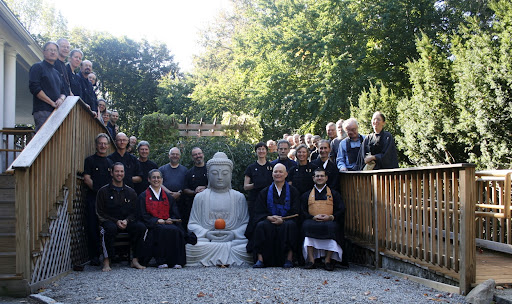
The official photo from the retreat we completed on Sunday afternoon.  Such a blessing to do this work of waking up within the support and company of others.  Thanks to everyone who came and everyone who supported to make this possible.  And special thanks to Harriet who took the photo!

Tuesday, October 4, 2011

Hearing Voices


            I was minding my own business the other morning – just tidying up the gardens near the side-walk with no one else around - when I heard someone say to me in a sing-songy voice, “Why won’t you let me love you?” 
Since God does not yet usually speak to me in such a direct manner, I looked around for the source of the question.  All I saw was the backside of a sweaty woman jogging by wearing earphones. 
I was both relieved and disappointed she didn’t seem to be talking to me personally.  But then I realized that she was obviously a secret messenger – so far undercover that she herself did not even know she had been chosen to carrying this message to me.
            The rest of the day, I’ve been contemplating her question: “Why won’t you let me love you?”  I take it mostly as an invitation to receive something that is already here.  What if this is the question from the leafy stillness of the trees?  From the flat humility of the sidewalk?  From the shushing sound of the passing cars?
            I consider the possibility of relaxing my heart long enough to let in what I have been longing for all my life.  Of course, I don’t really know how to do this, but even in the imagining, something slips in.  I see through, for a moment, the ancient delusion of separateness. 
I smile in recognition of my silliness and go on with my day.